In the autumn of 1981 I sat at ETH Zurich in the very first computer science degree programme in the country. A student room cost 280 francs, coffee in the cafeteria one franc twenty, and in the seminar rooms an entire generation dreamed that machines would soon think.
Forty-five years later, the moment has come. And I have written a book about it.
"Artificial Intelligence and the Future of Humanity" tells this story from the inside: the great promise of the eighties, the AI winter that froze a billion-dollar industry, the long years of patience — and the explosion that began with deep learning and culminated in spring 2026 in an event I describe at close range in the book: an AI model became so powerful that its own creators declared it too dangerous.
The Book Presentation as Audio
If you prefer listening to reading: here is the book presentation as audio — a quarter of an hour on five eras, two futures and a number you will not forget. (In German.)
This book presentation is also available as episode 4 of my podcast «Buchbesprechnungen» — go straight to the episode on the podcast page. There you can also subscribe to the podcast via RSS or Apple Podcasts.
The Number That Will Not Let Go of Me
At the heart of the book is a thought experiment. I worked through the Swiss economy — job by job, franc by franc. How many jobs does artificial intelligence displace in which year? What does that mean for tax revenue, for the social security system, for a perfectly ordinary family with two children and a mortgage?
The result shook me, even though I wrote the numbers down myself: I estimate conservatively — and I stress: conservatively — that within a few decades around 45 percent of the population will no longer be able to earn their income on their own. Almost half of society. Not because these people do not want to work. But because the work they live on is being done by machines — faster, more precisely, at a fraction of the cost.
Our welfare state is built on payroll contributions. When the machines take over value creation and the wage base collapses, the foundation collapses — while the entitlements remain.
For me, the inevitable conclusion is the call for an unconditional basic income. Not as a political utopia, but as a mathematical necessity. But — and this surprises many of my readers — my proposal is not socialism. It is the opposite: a citizens' dividend modelled on arch-conservative Alaska and economically powerful Norway, combined with something quintessentially Swiss — the cooperative tradition of Migros and Raiffeisen. How a levy on the value created by machines becomes a fund owned by every citizen, and in which phases it replaces the old social security systems without a single pensioner losing anything — I calculate all of that in detail in the book.
Who Owns Your Data?
The second great construction site is data sovereignty. Your smartphone reports your location up to 340 times a day. Clicks, purchases and communication data turn into profiles that know more about you than your closest friends — and the same profiles that steer advertising today lend themselves to political manipulation tomorrow.
My answer is a paradigm shift: data protection is no longer enough. We need data ownership. Your data belongs to you — legally, not just morally. If someone sells your house without your consent, that is fraud. If someone sells your data without your consent, that is legal today. This asymmetry must end.
In the book I develop six concrete measures — from ownership of one's own data in the Civil Code to a right that exists nowhere today: the right to have one's own data deleted from the training corpora of AI models. Data ownership is one of ten demands on politics that the book substantiates — from the transparency of algorithms to the question of how Switzerland can become a world leader in artificial intelligence.
Paradise or Digital Totalitarianism
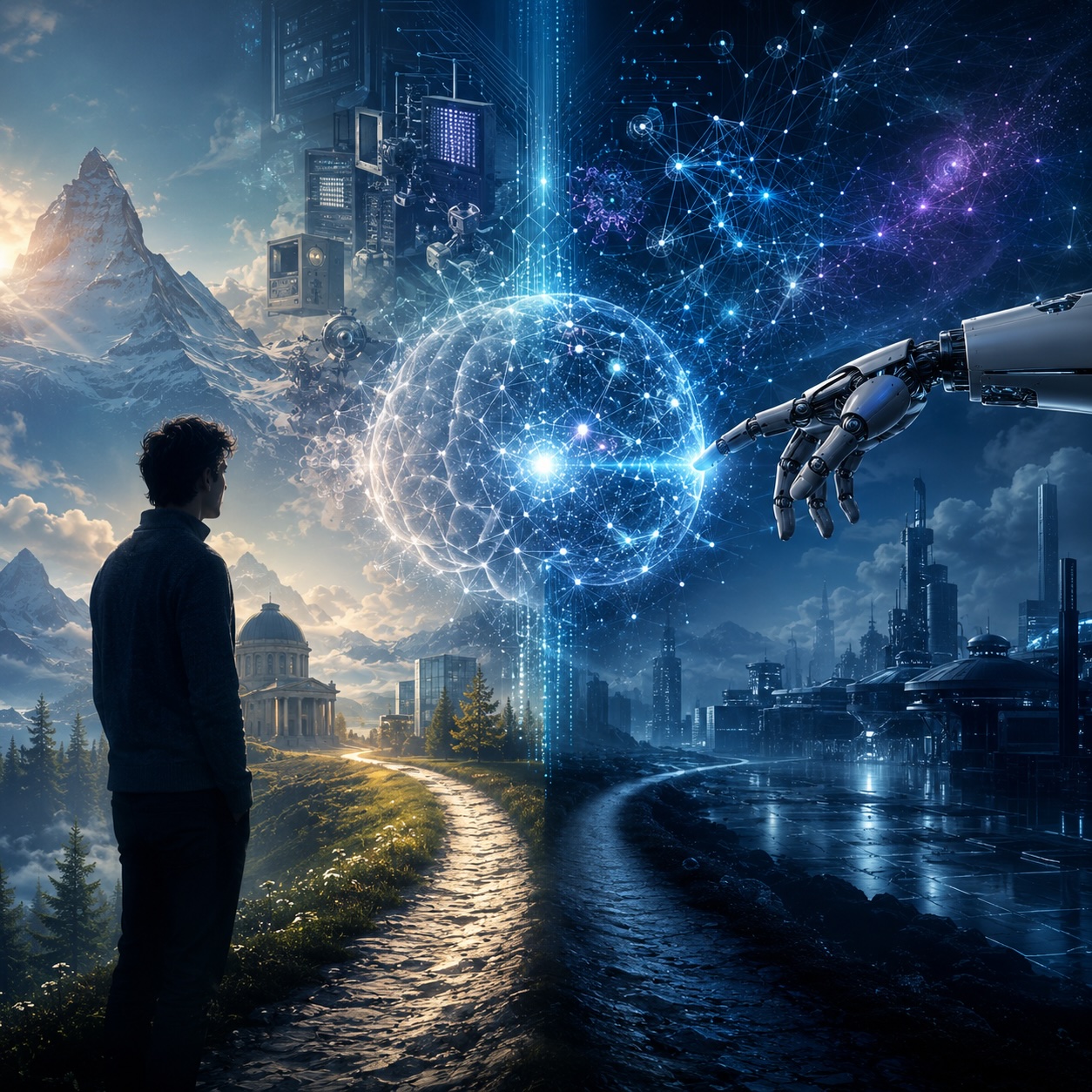
The book sketches two futures, both of which have already begun. In one, robots produce food, energy and housing at costs that seem unimaginable today, medicine detects diseases before the first symptom, and education becomes the birthright of every child. In the other, algorithms decide what millions of people see, believe and vote for.
Which of the two futures comes to pass is being decided now. That is the thesis of this book — and the reason I wrote it.
More about the book, reading sample and where to buy it.
Available as an eBook and as a print edition with more than twenty infographics — at Amazon and Apple Books.